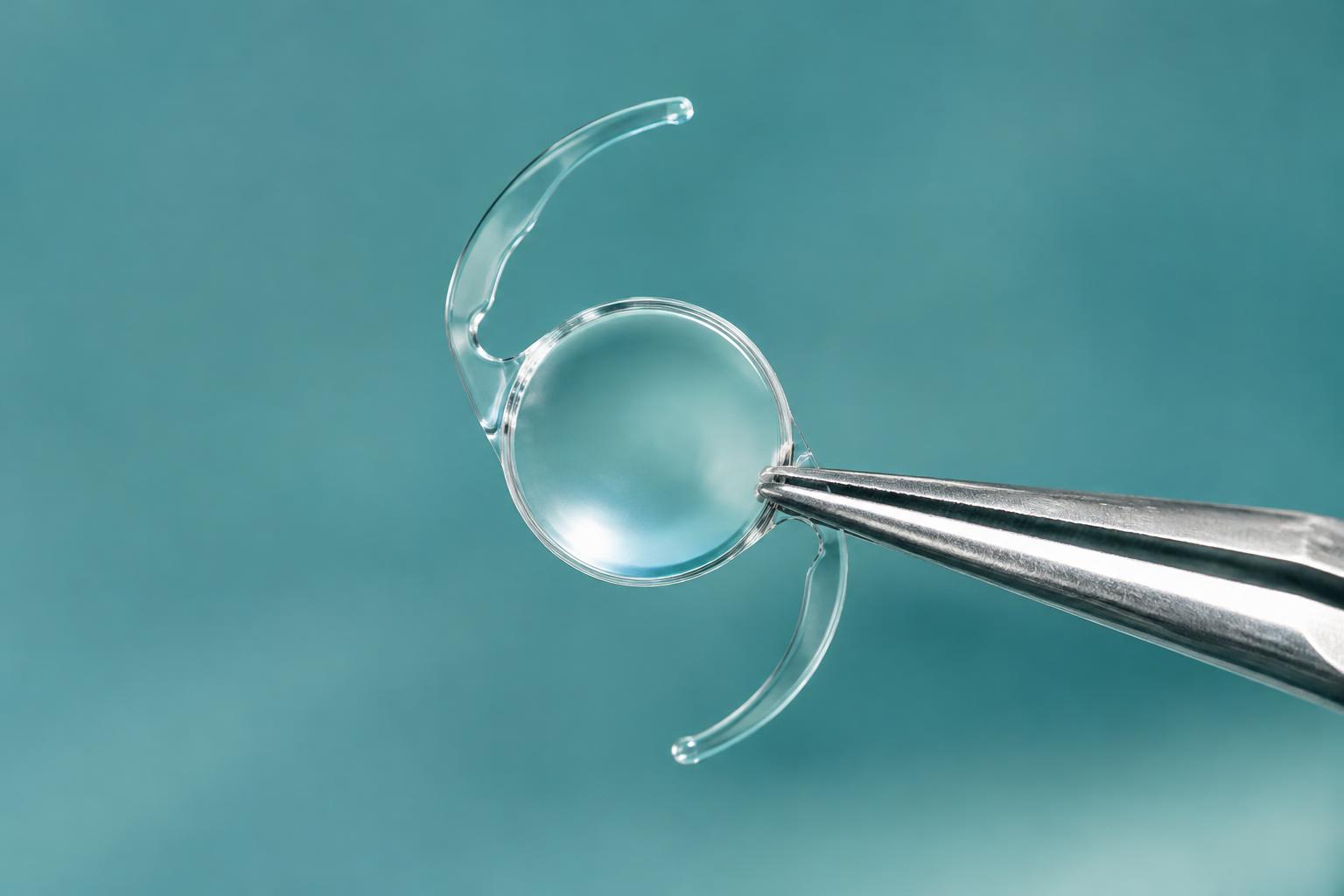
During cataract surgery, your cloudy natural lens is removed and replaced with a tiny artificial lens called an intraocular lens, or IOL. It is designed to stay in your eye permanently, so choosing the right one is one of the most important decisions you will make on your cataract journey. The good news is that today there are more options than ever, and with the right advice you can match the lens to your eyes, your hobbies and the way you want to live.
This guide explains the main types of lens implant, the pros and cons of each, and the questions worth asking your surgeon. If you are still at the stage of wondering whether you have a cataract at all, start with our guide to the early signs of cataracts.
Why the lens choice matters
The natural lens of a young eye can change shape to focus at different distances, a process called accommodation. With age this flexibility fades, which is why most people need reading glasses from their mid-forties. Artificial lenses do not change shape in the same way, so each design takes a different approach to delivering clear vision at distance, intermediate range and near.
There is no single "best" lens. The ideal choice depends on:
- Your general eye health, including the retina and the surface of the eye.
- Whether you have astigmatism, an uneven curvature of the cornea.
- How you use your eyes every day: driving, reading, computer work, crafts, sport.
- How much you mind wearing glasses.
- Your tolerance for possible side effects such as halos around lights.
How the lens power is chosen
Before surgery you will have biometry, a set of quick, painless measurements of the length of your eye and the curvature of your cornea. These figures are fed into specialised formulas to calculate the exact lens power needed. Accurate biometry is what makes modern cataract surgery so predictable, and it is also the point at which you and your surgeon agree on the visual "target" for each eye.
Monofocal lenses
Monofocal lenses are the most widely used implants in the world. They focus light at a single distance, which is usually set for clear distance vision.
Advantages:
- Excellent quality of vision at the chosen distance.
- Very low risk of glare or halos.
- Suitable for almost everyone, including people with other eye conditions.
- The standard lens offered in most NHS cataract services.
Things to consider:
- You will usually need reading glasses for close work, and sometimes glasses for computer use.
For many people, crisp distance vision with a pair of reading glasses is a perfectly happy outcome, especially compared with the cloudy sight they had before.
Monovision with monofocal lenses
A popular variation is monovision. One eye is set for distance and the other is set slightly short-sighted for intermediate or near tasks. The brain learns to use each eye for different jobs. Some people adapt very well, particularly if they have successfully used monovision contact lenses before, while others find it uncomfortable. It is often worth trialling the idea with contact lenses first.
Multifocal and trifocal lenses
Multifocal lenses split incoming light into two or three focal points, giving clear vision at distance and near, and in the case of trifocal lenses at intermediate range as well. The aim is to reduce, and for many people eliminate, the need for glasses after surgery.
Advantages:
- Many patients can read, use a computer and drive without glasses.
- Ideal for people who strongly value independence from spectacles.
Things to consider:
- Halos and glare around lights at night are common, especially in the first few months, although most people adapt over time.
- Contrast can be slightly reduced, particularly in dim light.
- They are generally not suitable for people with macular disease, advanced glaucoma or significant dry eye.
- They are usually offered as a premium, privately funded option.
Extended depth of focus lenses
Extended depth of focus lenses, often shortened to EDOF, stretch the range of clear vision from distance into the intermediate zone rather than splitting light into distinct points. They are a middle ground between monofocal and multifocal designs.
Advantages:
- Good distance and computer-range vision.
- Fewer night-time halos than many multifocal lenses.
Things to consider:
- Many people still need light reading glasses for small print.
Toric lenses for astigmatism
Astigmatism means the front of the eye is shaped more like a rugby ball than a football, which blurs vision at all distances. A standard lens does not correct this, so a person with significant astigmatism may still need glasses for distance after surgery.
Toric lenses have extra correction built into one axis. The surgeon carefully rotates the lens into the correct position during the operation to cancel out the astigmatism. Toric versions are available for monofocal, multifocal and EDOF designs.
Advantages:
- Sharper, more natural uncorrected vision for people with astigmatism.
- Reduced reliance on glasses.
Things to consider:
- The lens must stay in exactly the right orientation. Occasionally a small repositioning procedure is needed if it rotates.
Comparing the options at a glance
- Monofocal: clearest single-distance vision, fewest side effects, reading glasses usually needed.
- Monovision: reduced need for glasses, but requires adaptation and may reduce depth perception slightly.
- Multifocal or trifocal: greatest freedom from glasses, with a higher chance of night-time halos.
- EDOF: strong distance and intermediate vision with fewer halos, sometimes reading glasses for fine print.
- Toric: corrects astigmatism and can be combined with any of the above.
The best lens is the one that fits your eyes and your life, not simply the most expensive one on the list.
Questions to ask your surgeon
Bringing a short list of questions to your consultation helps you get the most from it:
- Is my eye healthy enough for a premium lens?
- Do I have astigmatism, and would a toric lens help?
- Which distance should my lens be set for, given my hobbies and work?
- How likely am I to need glasses afterwards, and for what?
- What side effects are most likely with the lens you are recommending?
- What happens if I am not happy with my vision after surgery?
To understand how lens choice fits into the overall treatment process, from your first appointment to the operation itself, read our complete patient guide to cataract surgery in Winchester.
Thinking about your lifestyle
It can help to picture an ordinary week. Do you spend hours on a laptop? Do you drive long distances at night? Are you a keen golfer, painter, reader or knitter? A retired keen reader may prefer a different set-up from a professional driver or someone who spends most of the day at a screen.
Be honest about how much you mind wearing glasses. Some people are entirely comfortable popping on readers and prefer the sharpest possible distance vision. Others would happily accept some night-time halos in exchange for rarely wearing glasses. Neither choice is wrong.
After the lens is in place
Your new lens cannot be felt, does not need cleaning and should last a lifetime. It may take a few weeks for your vision to stabilise and for your brain to adapt, particularly with multifocal designs. Our week-by-week recovery guide explains what is normal in the days and weeks after surgery and when to book an eye test for new glasses.
It is also worth remembering that an artificial lens replaces only the lens. The rest of the eye, including the retina and optic nerve, still benefits from regular check-ups and healthy habits. Find out more in our article on protecting your eye health as you age.
The bottom line
Monofocal lenses offer reliable, high-quality vision at one distance. Multifocal, trifocal and EDOF lenses broaden your range of clear sight and reduce your need for glasses, with some trade-offs. Toric lenses correct astigmatism and can be combined with any design. A careful assessment and an open conversation with your surgeon will help you choose the lens that is right for you.